Why does month-end close take so long? Six bottlenecks Use Cases
When the close stretches to six days, the problem is usually the process, not the team. Here are the six bottlenecks we meet most often — and the practical fix for each.
Atilla Kuruüzüm · June 23, 2026
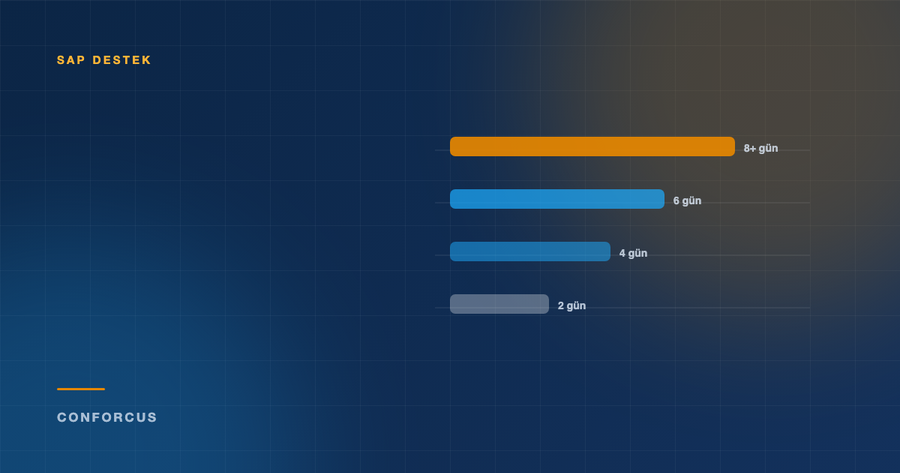
The most revealing question we ask in first meetings with finance teams is simple: how many days does your month-end close take? If the answer is three, the system is largely working. If it is six or more, the problem is almost never the team's speed.
The six bottlenecks below appear again and again across industries. What they share is that none of them is a “we can't use SAP” problem — they all come from missing design and automation.
1. Accrual postings built by hand
Spreading insurance, rent, maintenance and subscription costs across months is recurring work. Posted manually, it creates two problems: preparation time and the risk of a forgotten item. When a contract term changes, the remaining months usually go un-updated.
The fix is to tie accruals to the purchase document or invoice and let the system generate the schedule. At close, the work becomes reviewing a list rather than making postings.
2. Reconciliations piling up at period end
When account reconciliations are done in bulk during close week, there is no time left to investigate the differences that surface. A gap is found but its origin is not, which leads either to temporary postings or to issues carried into the next period.
Companies that spread reconciliation across the month close visibly faster. Generating reconciliation letters in bulk from the system and tracking responses per account is the most practical step that makes this possible.
3. Costing analysis done one item at a time
In companies using the material ledger, price differences are often reviewed material by material, opening the transaction each time. Across hundreds of materials this becomes the longest step of the close, and missed deviations carry into later periods.
A report that runs in bulk does the same job in minutes. What matters is listing abnormal deviations — not reviewing every material, but finding the ones that need review.
4. Reports built outside SAP
When COGS statements, ageing and FX analyses are built in Excel, they are rebuilt at every close. Formulas are fragile, the link to source data is broken, and answering an audit question takes extra work.
Moving these reports into SAP does more than save time; it makes the origin of a number demonstrable. Audit and accountant requests turn into presenting a document rather than a discussion.
5. Invisible approval processes
Sometimes what holds up the close is not a posting but an approval: a pending purchase document, an unapproved price difference, an unresolved reservation. When it is not visible where documents are waiting, the close team tracks them down by phone.
A report listing approval status with tier and waiting time removes that chase. In most companies, the fact that the bottleneck sits in one single approval tier only becomes apparent once it is measured.
6. No written close calendar
The order of close steps and their owners usually live in the memory of a few experienced people. When they are on leave, the close takes longer; a newcomer learns the process only over months.
A written close calendar with steps, owners, dependencies and target durations is the lowest-cost improvement available. You cannot shorten a process you do not measure, and the calendar is where measurement starts.
Where to begin
The practical way to find which of these six costs you most is to write down which step delayed your last three closes. Usually a single bottleneck explains more than a third of the total duration.
Shortening the close does not require a large transformation programme; a few automations placed correctly are often enough. What matters is measuring which step is genuinely expensive rather than guessing.
Frequently asked questions
What is a healthy close duration?
Three days or less indicates the system is largely working. Eight days or more is almost never about team speed — it points to missing design and automation.
Does shortening the close require a large project?
Usually not. A few automations placed correctly — accruals, reconciliation, bulk costing analysis — recover a significant share of the total duration.
Where should we start?
Write down which step delayed your last three closes. In most companies a single bottleneck explains more than a third of the total duration.